Scoring well isn’t just about knowing the content — it’s about answering with precision, speed, and confidence.
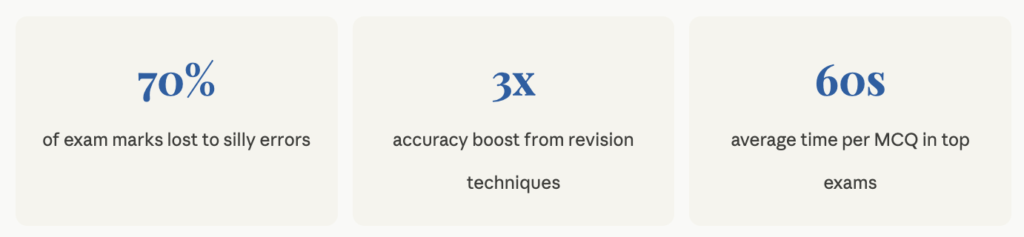
Multiple-choice questions are deceptively tricky. Whether you’re preparing for JEE, NEET, EAMCET, or any state-level competitive entrance exam, the difference between a rank and a miss often comes down to accuracy — not just speed. Students who read every option carefully, manage their time wisely, and eliminate wrong answers confidently consistently outperform those who rely on raw knowledge alone.
Here’s a comprehensive guide to sharpening your MCQ accuracy from the ground up.
1. Master the art of elimination
In most well-designed MCQ papers, at least one or two options are clearly incorrect. Train yourself to spot and cross out these distractors before committing to an answer. This “process of elimination” strategy narrows your chances from 1-in-4 to 1-in-2, dramatically improving accuracy — especially under pressure when you’re unsure.
Quick tip: Cross out the option you’re most sure is wrong first. Then evaluate the remaining two calmly. Often your instinct narrows it down further.
2. Read the question twice — always
A staggering number of marks are lost because students misread keywords like “not,” “except,” “always,” or “most likely.” Developing the habit of reading every question at least twice — once for gist and once for precision — catches these traps before they catch you. Underline negative words or qualifiers mentally as you read.
3. Don’t let one hard question derail you
Time management is accuracy management. If you spend five minutes on a single question, your brain gets tired and rushed on the next ten. Adopt a two-pass strategy:
- In the first pass, answer every question you’re confident about.
- Mark uncertain questions and move on without guilt.
- Return to marked questions in the second pass with a fresh perspective.
This keeps your accuracy high on questions you know and gives you a calmer mindset for the harder ones.
4. Build concept clarity, not just memory
MCQs at the competitive level test understanding, not rote recall. A question may present a concept in a completely unfamiliar context. Students with deep conceptual clarity adapt instantly; those who’ve only memorised formulas get thrown. Focus your study sessions on the “why” behind every principle — ask yourself why a formula works, not just what it is.
Practice method: After solving a question, explain its logic aloud in your own words. If you can’t, you haven’t understood it yet — and that’s the version that trips you up in exams.
5. Analyse your mock test errors ruthlessly
Mock tests are only valuable if you treat the analysis as seriously as the test itself. After every practice paper, categorise your wrong answers:
- Concept gap — You didn’t know the topic at all.
- Silly mistake — You knew it but made a calculation or reading error.
- Guess gone wrong — You marked without confidence and lost marks.
Each type requires a different fix. Concept gaps need revision. Silly mistakes need slowing down. Poor guesses need better elimination technique. Most students treat all errors the same — that’s why they repeat them.
Studying in Hyderabad? If you’re looking for the top junior college in Hyderabad to prepare for JEE, NEET, or EAMCET, structured guidance and expert faculty make all the difference. Institutions that combine rigorous mock testing with personalised feedback produce students who not only study hard — but study smart.
6. Understand negative marking strategy
Blind guessing in negative-marking exams destroys accuracy scores. A good rule of thumb: only attempt a question if you can eliminate at least two options. If you have zero idea and all four options look equally plausible, skip it. The math is simple — a wrong guess in a -0.25 scheme means you need to get the next question correct just to break even.
7. Practice under timed conditions every single day
Accuracy in practice doesn’t always translate to accuracy in pressure. The solution is simple: simulate exam conditions during practice. Set a timer. Sit in a quiet space. Don’t check your phone. Students who practice with these constraints consistently score better in actual exams because the pressure feels familiar, not shocking.
8. Strengthen your weak topics systematically
Every student has subject blind spots — a chapter, a formula category, or a concept that never quite sticks. Rather than avoiding these, schedule weekly deep-dives into your weakest areas. Use targeted question banks, work through previous-year questions topic-wise, and track your improvement percentages. Accuracy improvement is a data problem as much as a study problem.
Consistency beats intensity: 45 focused minutes of targeted weak-topic practice daily outperforms a 5-hour cramming session once a week — every time.
9. Work on your reading speed and comprehension
In science and maths MCQs, reading speed is less critical — but in reasoning, general knowledge, and English sections, slow readers lose precious seconds per question. Practice skimming questions for keywords, and train yourself to extract the core question within two seconds of reading. This frees up time for careful answer evaluation.
The bottom line
Accuracy in competitive MCQ exams is a learnable skill — one that improves dramatically with the right techniques, honest self-analysis, and consistent structured practice. It’s not about being the smartest student in the room; it’s about being the most disciplined and methodical one.