

Most timetables fail by the second week
Almost every JEE and NEET aspirant has written the perfect timetable at least once. It starts at 4:30 a.m., packs in 14 hours of study, has no breaks, and looks impressive on the wall. By the tenth day, it's quietly abandoned.
The problem isn't discipline. The timetable was never built for a real student. It ignored travel, college hours, meals, tiredness and the fact that the brain can't focus at full strength for 14 hours straight.
Good time management for IIT-JEE and NEET isn't about squeezing in more hours. It's about using the hours you actually have, every single day, for two years. This guide shows what a realistic daily timetable looks like, how it should change from Class 11 to the final months, and the habits that make it stick.
Five principles of a realistic timetable
1. Start with fixed blocks, not study hours. College or coaching hours, meals, travel and sleep are not negotiable. Mark them first. Whatever is left is your real study time, and it's usually less than you hoped. That's fine. Planning with honest numbers is what makes a timetable last.
2. Protect seven to eight hours of sleep. Memory is consolidated during sleep. A student who sleeps five hours to study two more usually remembers less, solves slower and makes more silly mistakes in tests. Sleep is part of preparation, not a break from it.
3. Study in focused blocks with short breaks. Most students concentrate well for 50 to 90 minutes. After that, quality drops. A block of 60 to 75 minutes followed by a 10-minute break gets far more done than three hours of tired staring at a page.
4. Match the task to your energy. Use your sharpest hours for the hardest work: Physics problems, Maths, organic mechanisms. Keep lighter tasks such as NCERT reading, formula revision and flashcards for the times when energy dips.
5. Every class needs same-day revision. A concept learned in the morning and not touched until the weekend fades quickly. Even 20 to 30 minutes of review on the same evening makes it far easier to retain.
A realistic weekday timetable
This is a sample for a student in an integrated Intermediate + JEE or NEET programme. Treat it as a template and adjust the times to fit your own college schedule.
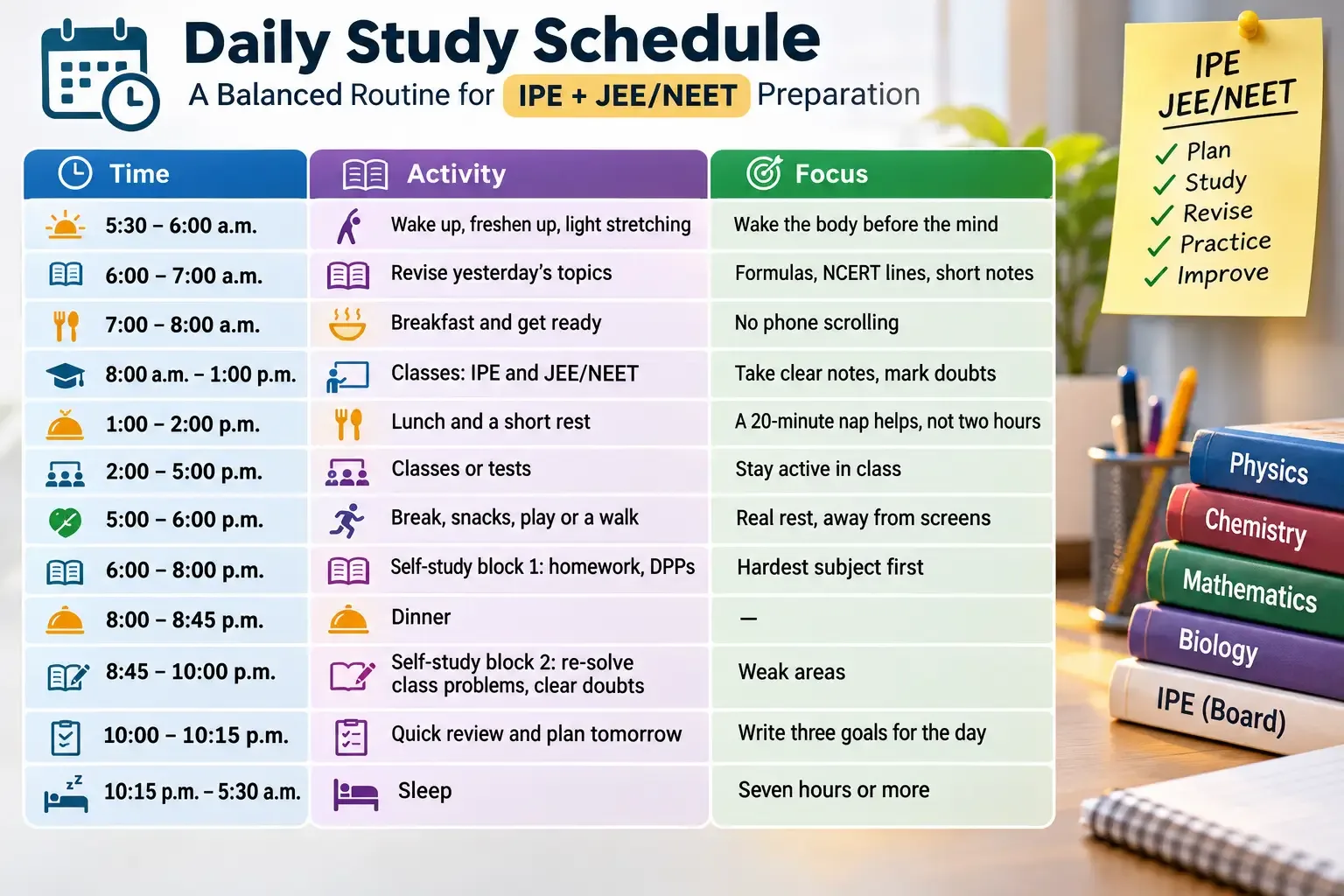
That adds up to roughly four hours of self-study on top of classes, with seven hours of sleep. It's realistic, and it can be repeated for months without burning out.
Sundays and holidays
Sundays shouldn't be a second weekday or a full day off. A good pattern is:
- Morning: A full-length mock test in exam timing
- Afternoon: Detailed analysis of the test, with every mistake logged
- Evening: Weekly revision of the topics covered that week, plus planning for the next week
- Night: Some genuine free time with family or friends, then an early bedtime
How the timetable changes over two years
Class 11: Most time goes into learning new concepts. Self-study focuses on completing homework, building notes and forming daily habits.
Class 12: New chapters continue, but self-study shifts toward revising Class 11 alongside Class 12, solving mixed problems and preparing for board exams.
Final three to four months: Classes give way to revision. Mock tests increase to two or three a week, and their analysis takes up a large share of the day. Sleep stays protected, especially in the final weeks.
Habits that make the timetable work
- Plan tomorrow tonight. Spend five minutes before bed writing the three most important tasks for the next day. Mornings start with direction instead of indecision.
- Keep a mistake notebook. Log every error from tests and homework, and revise it every Sunday. It's the fastest way to stop losing marks to the same mistakes.
- Track hours honestly for one week. Note what you actually did each hour. Most students discover one to two hours a day disappearing into small distractions.
- Give weak subjects fixed slots. If Physics scares you, it gets a fixed daily block. Otherwise it's always the one that gets skipped.
- Clear doubts within 24 hours. One unresolved doubt quickly turns into several.
- Move a little every day. A 20-minute walk or game resets focus better than another hour of tired study.
The biggest time-wasters (and how to fix them)
- Phone "just for a minute." Keep it out of the study room, or switch it off during study blocks.
- Long travel. Use commute time for audio revision or formula cards, or choose a college that removes the commute altogether.
- Over-planning. Making colour-coded plans feels productive, but it isn't studying. Keep the plan simple.
- Endless video lectures. Watching a solution isn't the same as solving it. Limit videos to doubts you couldn't clear otherwise.
- Late nights before tests. Cramming past midnight hurts recall the next morning. Sleep wins.
How VR Junior College builds time management into the day
A timetable is easier to follow when the environment supports it. That's why many families looking for the best junior college in Hyderabad for IIT-JEE and NEET choose a campus where the routine is already structured.
At VR Junior College, Intermediate education is combined with integrated coaching across campuses in Miyapur, Hafeezpet, Madhapur, Bowrampet and Hayathnagar.
- Integrated programmes: MPC with IIT-JEE (VRiiT), BiPC with NEET (VR Doctors Academy) and NEET Long Term
- A structured learning cycle: Learn, Practise, Perform, Analyse. Concepts are taught first, practised until they become natural, tested under time limits and reviewed in detail after every test.
- Time management in exams: Regular tests build time management, paper management and accuracy, so students learn to use every minute of the actual exam well.
- Readiness-based batches: After three months, students are assessed and placed in Vision 40 or Future 50, so their daily workload matches their level. The fee stays the same.
- A disciplined residential environment: Separate boys' and girls' hostels with 24/7 supervision, fixed daily routines and hygienic meals remove the commute and most distractions. Day-scholar options are available too.
- Personal mentorship: Mentors track each student's progress and help them adjust their plans when something isn't working.
Admissions for 2026–27 are open. Visit a campus, see what a full day looks like, and ask how your child's time will be used. Call +91 89298 28498 or +91 92569 25643, or enquire online.
Frequently asked questions
The best timetable fits around fixed college or coaching hours and includes morning revision, focused classes, two evening self-study blocks of about two hours each, short breaks, regular meals and seven to eight hours of sleep. Consistency over months matters more than the exact times.
Most successful aspirants in integrated programmes study about four to five hours on their own daily, in addition to six to eight hours of classes. Focused, consistent study beats long, distracted hours. Increase self-study gradually in Class 12 and the final months.
Yes, and it's recommended. Sleep helps the brain store what you learned during the day. Cutting sleep to study more usually reduces focus, memory and accuracy in tests. Seven to eight hours a night supports better performance over a long preparation period.
Use the same core concepts for both, since the syllabi overlap heavily. Keep regular practice of board-style answers in your weekly plan, and give dedicated revision time to board exams about two to three months before they begin, while continuing mock tests for JEE or NEET.
Start with one full-length mock test every week or two in Class 12, then increase to two or three a week in the final three to four months. Analysing each test and logging mistakes is as important as taking it.
Keep your phone away during study blocks, plan tomorrow's three main tasks the night before, study in 60- to 75-minute blocks with short breaks, and track your hours honestly for a week to see where time is being lost.
The best junior college in Hyderabad for IIT-JEE and NEET offers integrated coaching, experienced faculty, a structured daily routine, regular tests with analysis and personal mentorship. VR Junior College offers MPC with IIT-JEE and BiPC with NEET across multiple Hyderabad campuses, with residential and day-scholar options.