
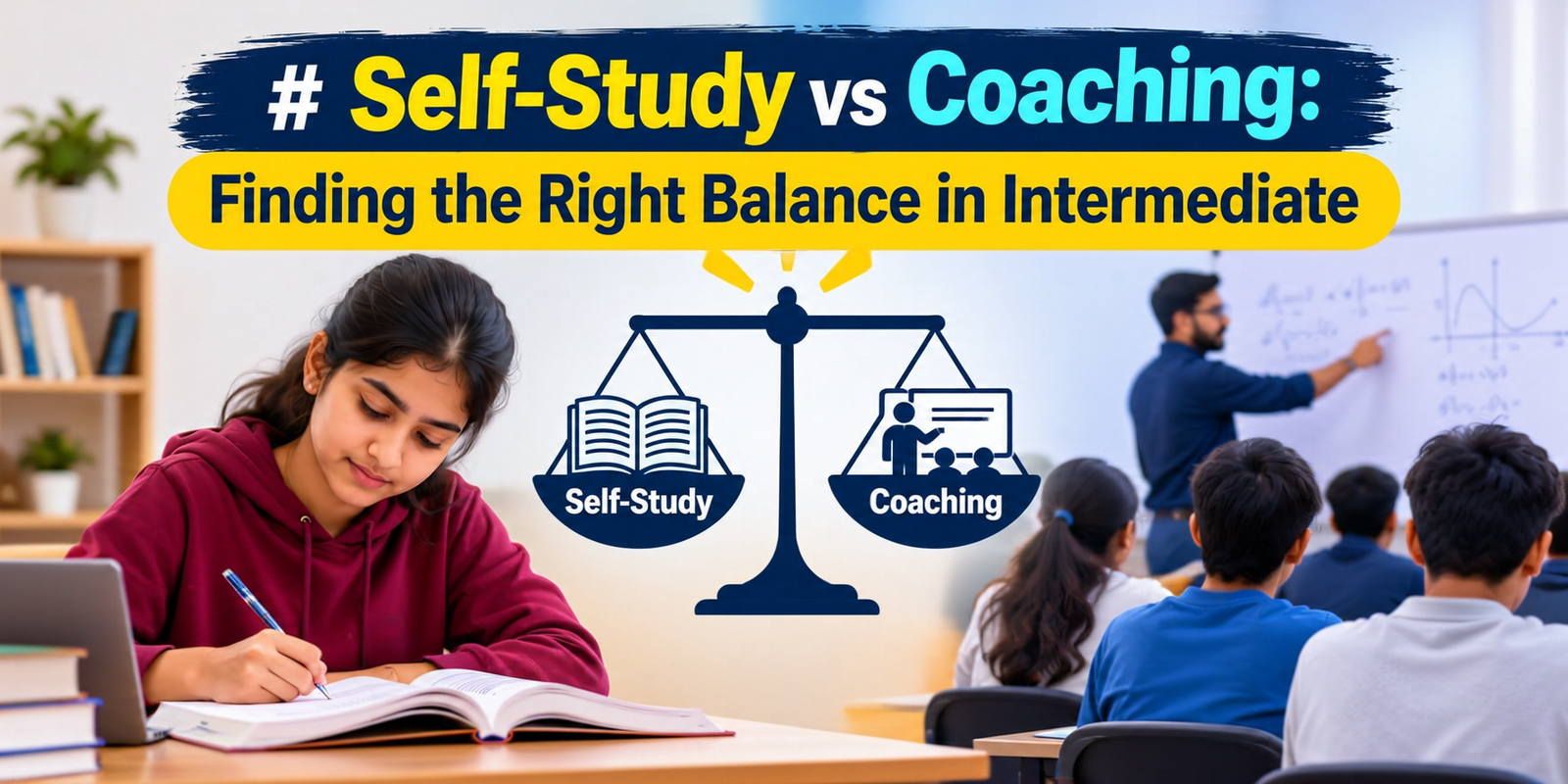
The question every Intermediate family argues about
In most homes with a Class 11 student, the same debate comes up within the first few months. One side says the child needs more coaching, more classes and more tests. The other says they're sitting in classes all day and never get time to actually study.
Both sides are partly right. Coaching and self-study do different jobs, and Intermediate students need both. A student who only attends classes ends up with notebooks full of solved problems they can't solve alone. A student who only self-studies often goes deep on comfortable chapters and misses what the exam actually asks.
The real question isn't which one is better. It's how to split the day so each does its job. Here's how to think about it, what a healthy balance looks like across the two years, and why the best residential college in Hyderabad treats self-study as part of the timetable, not an afterthought.
What coaching does well
Good coaching gives students three things that are hard to get alone.
Structure. The Intermediate syllabus, plus JEE or NEET on top, is huge. Coaching breaks it into a sequence that makes sense, so students aren't jumping from optics to organic chemistry with no plan.
Expert explanation. Some topics, like rotational motion, electrochemistry or genetics, are genuinely hard to crack from a textbook. An experienced lecturer who has taught a concept for 15 or 20 years knows exactly where students get stuck and how to unblock them.
Exam exposure. Regular tests, question patterns and time limits are what turn knowledge into marks. Very few students can recreate that pressure on their own.
What self-study does well
Self-study is where learning actually sticks. In class, a student watches a problem being solved. At their desk, they find out whether they can solve it themselves.
It does three things coaching can't:
- Converts understanding into ability. Re-solving class problems without looking at the solution is how a concept moves from "I understood it" to "I can do it."
- Builds memory. NEET Biology and Chemistry, in particular, need repeated revision of NCERT lines, diagrams and reactions. That happens only in quiet, personal study time.
- Fixes individual weak spots. Every student's gaps are different. Self-study is the only time a student can spend an extra hour on the one chapter that keeps costing them marks.
Signs the balance is off
Most students don't notice the imbalance until their test scores tell them. Watch for these signals.
Too much coaching, too little self-study:
- Classes feel clear, but test scores don't improve
- Homework and DPPs pile up unfinished
- The student can follow a solution but can't start a problem alone
- Constant tiredness, with no time left for revision
Too much self-study, too little guidance:
- Hours spent on favourite subjects while weak ones are avoided
- Doubts stay unresolved for days
- Preparation drifts away from the actual exam pattern
- No regular tests, so the student has no idea where they stand
If you recognise your child in either list, the fix isn't more hours. It's a better split.
Finding the right balance
There's no single perfect ratio, but most successful Intermediate students follow the same principle: every hour of class needs a matching block of self-study the same day. Learning that isn't revisited within 24 hours fades fast.
What a balanced day can look like
For a student in an integrated IPE + JEE or NEET programme, a typical day might be split like this:
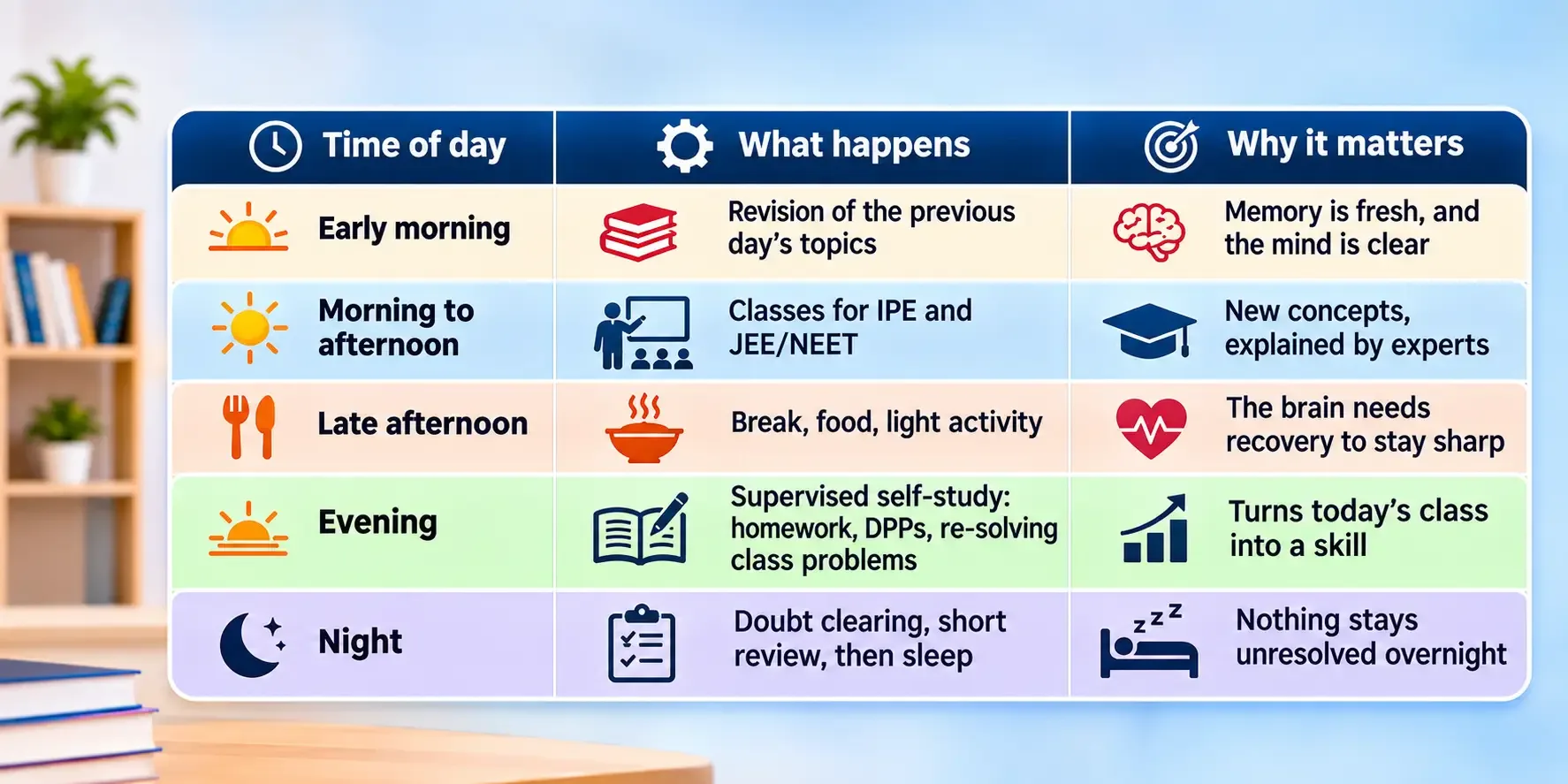
Sleep is part of the plan, not a reward at the end of it. Students who cut sleep to add study hours usually lose more in focus than they gain in time.
How the balance shifts over two years
First year (Class 11): Coaching takes the larger share. Students are meeting most concepts for the first time and need strong explanations. Self-study focuses on completing practice and building daily habits.
Second year (Class 12): The split moves toward self-study. New concepts still arrive, but more time goes to revising Class 11, solving mixed problems and preparing for board exams.
Final months before exams: Self-study and testing take over. Classes shrink to doubt sessions and revision, while full-length mock tests and their analysis fill most of the week.
Five habits that make the balance work
- Review the same day. Spend at least a short block revisiting every class before bed.
- Solve before you look. In self-study, attempt every problem fully before checking the solution.
- Keep a mistake notebook. Write down every error from tests and homework, and revise it weekly.
- Plan the week, not just the day. Give weaker subjects fixed self-study slots so they can't be skipped.
- Clear doubts within 24 hours. A doubt left for a week usually becomes three new doubts.
Why a residential college makes the balance easier
At home, self-study competes with everything else: phones, TV, travel time, family events and the simple temptation to "start after dinner." Many students lose two to three productive hours a day to commuting and distractions alone.
A well-run residential college removes that friction. Classes and self-study happen in the same place, on a fixed schedule. Evening study hours are supervised, so they actually get used. Faculty are close by, so doubts are cleared the same day instead of waiting for the next class. That's why parents searching for the best residential college in Hyderabad are rarely looking for just a hostel. They're looking for a system that protects study time.
VR Junior College: built around both coaching and self-study
At VR Junior College, the name stands for Vision Into Reality, and the approach is built on the idea that no child is made for just one exam. The college combines Intermediate education with integrated coaching across campuses in Miyapur, Hafeezpet, Madhapur, Bowrampet and Hayathnagar.
- Integrated programmes: MPC with IIT-JEE (VRiiT), BiPC with NEET (VR Doctors Academy) and NEET Long Term
- A learning cycle that includes self-study: Learn, Practise, Perform, Analyse. Concepts are taught first, then practised until application becomes natural, then tested under time limits and reviewed in detail.
- Experienced faculty: Senior lecturers bring 16 to 22 years of teaching experience and stay available for doubt clearing.
- Readiness-based batches: After three months, students are assessed and placed in Vision 40 or Future 50, so coaching matches their level. The fee stays the same.
- A disciplined residential environment: Separate boys' and girls' hostels with 24/7 warden supervision and CCTV, structured daily routines and hygienic meals. Day-scholar options are also available.
- Personal mentorship: Mentors track each student's strengths and gaps, and guide them toward the path that fits them.
With more than 2,000 students guided over six academic years, VR has built a reputation as one of the best residential colleges in Hyderabad for MPC and BiPC.
Admissions are open. Visit a campus, see a day of classes and supervised study, and ask how your child's time will be used. Call +91 89298 28498 or +91 92569 25643, or enquire online.
Frequently asked questions
Neither works well alone. Coaching gives structure, expert explanations and exam exposure, while self-study turns that teaching into the ability to solve problems independently. Intermediate students preparing for IPE, JEE or NEET get the best results when every class is followed by focused self-study the same day.
Most students in integrated IPE and JEE or NEET programmes benefit from about three to five hours of focused self-study a day, alongside classes. The exact number matters less than consistency. Short, daily revision of each class works better than long, irregular study sessions.
Some students do, but it's rare and much harder. Without coaching, students often lack a structured plan, regular tests and quick doubt clearing. Most successful JEE and NEET aspirants combine expert coaching with disciplined daily self-study and regular test analysis.
In Class 11, coaching takes the larger share because most concepts are new. In Class 12, the balance shifts toward self-study for revision and mixed practice. In the final months, self-study and full-length mock tests take over, with classes mainly used for doubt clearing.
Residential colleges remove commuting time and home distractions, and they schedule supervised self-study hours after classes. Faculty are available for same-day doubt clearing, and a fixed routine makes revision a daily habit. This structure helps students use their time far more consistently than at home.
A good timetable includes morning revision of the previous day's topics, classes, a proper break, an evening block of self-study for homework and practice problems, time for doubt clearing and seven to eight hours of sleep. Weaker subjects should have fixed weekly slots.
The best residential college in Hyderabad combines experienced faculty, integrated IIT-JEE or NEET coaching, supervised self-study, regular test analysis and safe hostels. VR Junior College offers MPC with IIT-JEE and BiPC with NEET across multiple Hyderabad campuses, with readiness-based batches and personal mentorship.