
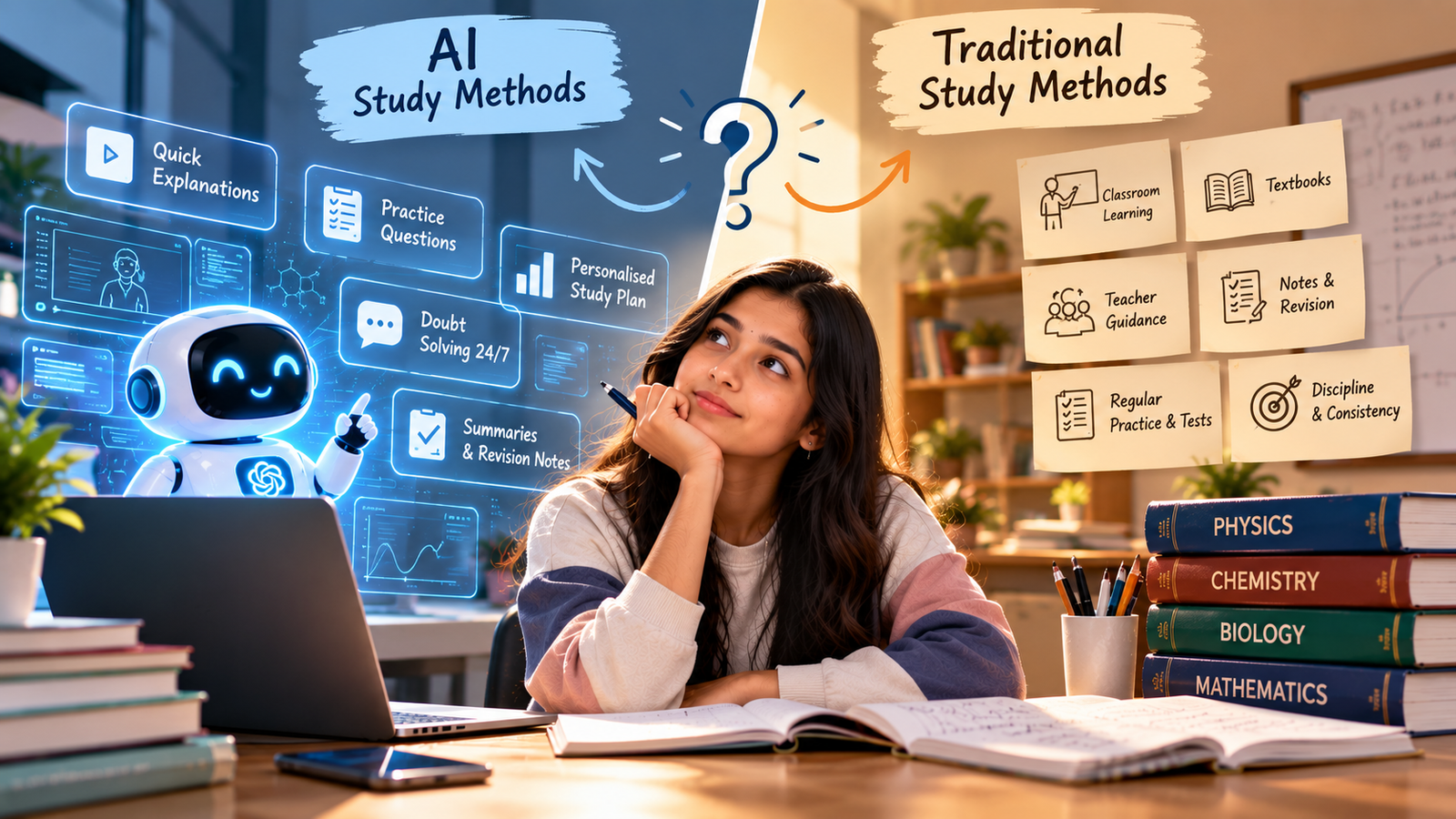
The way students study is changing rapidly. A few years ago, preparing for 11th and 12th-grade exams usually meant attending classes, reading textbooks, making handwritten notes, solving questions, and revising repeatedly. Today, students can also use AI tools to explain difficult concepts, create practice questions, summarize topics, and identify areas that need more attention.
This raises an important question: Is AI-based learning better than traditional study methods?
For junior college students, the answer is not as simple as choosing one over the other. AI can make learning faster and more personalized, but traditional methods continue to provide the foundation students need for strong conceptual understanding, discipline, memory, and exam performance.
The most effective approach is often a balanced combination of both.
What Are Traditional Study Methods?
Traditional learning does not necessarily mean outdated learning. It includes many methods that have remained useful because they require students to actively engage with what they are studying.
Common traditional methods include:
- Classroom teaching
- Textbook reading
- Handwritten notes
- Teacher explanations
- Doubt-clearing sessions
- Solving previous examination papers
- Practice tests
- Group discussions
- Revision schedules
- Self-study
For 11th and 12th students, these methods are particularly important because higher secondary education introduces concepts that become the foundation for competitive examinations and future academic study.
For example, a student preparing for Mathematics cannot depend only on an explanation of a formula. They need to understand the concept, remember the relevant principles, solve different types of problems, identify mistakes and practise until the process becomes familiar.
That is where traditional learning has a major role.
How AI Is Changing Student Learning
AI adds another layer to the learning process.
Instead of waiting for the next class to ask a question, students can use AI tools to receive explanations in different ways. A difficult Physics concept can be explained using a simple example. A Chemistry topic can be broken into smaller sections. A student can ask for additional practice questions after completing a chapter.
AI can also help students approach the same topic from different perspectives.
For example, if a student does not understand a particular Biology concept from a textbook explanation, they might ask an AI tool to explain it using a real-world example or simpler language.
This can make difficult topics feel more approachable.
However, convenience can also become a problem. If students start asking AI for every answer instead of attempting questions themselves, they may become dependent on assistance rather than developing independent problem-solving skills.
AI vs Traditional Learning: What Is the Difference?
The biggest difference is how the student interacts with the learning material.
Traditional learning generally follows a structured system. A teacher explains a topic, students practise it, assignments are given, tests are conducted, and feedback is provided.
AI learning is more flexible. Students can ask questions whenever they want, change the difficulty level, request examples, generate quizzes, or revisit a concept repeatedly.
Neither approach automatically produces better results.
The outcome depends on how actively the student participates.
Traditional learning is particularly useful for:
Conceptual foundations:
Teachers can explain concepts in context and connect them with the syllabus.
Discipline:
A fixed timetable encourages students to study consistently rather than only when they feel motivated.
Personal mentorship:
Teachers can notice changes in performance, participation and learning behaviour.
Exam-oriented practice:
Regular tests and assignments help students become comfortable with time limits and examination pressure.
Human interaction:
Classroom discussions allow students to learn from questions raised by other students.
AI can be particularly useful for:
Quick explanations:
Students can ask for simpler explanations when they are stuck.
Personalised practice:
AI can generate additional questions based on a particular topic or difficulty level.
Revision:
Students can use quizzes, flashcards and question-answer sessions to revise.
Brainstorming:
AI can help students organise ideas, compare concepts or create study plans.
Immediate feedback:
Students can use AI to review their reasoning and identify possible gaps, while still verifying important information.
Why Teachers Still Matter
One of the biggest misconceptions about AI in education is that technology can completely replace teachers.
For 11th and 12th-grade students, teachers provide much more than information.
A good teacher understands the curriculum, observes students over time and can identify patterns that an AI tool may not recognise. A teacher may notice that a student understands Chemistry concepts but struggles to apply them in numerical problems. They can then recommend a specific type of practice.
Teachers also provide accountability.
When students have regular classes, assignments, tests and discussions, they are more likely to maintain a consistent learning routine.
This becomes particularly important during 11th and 12th grade, when students are simultaneously managing board-level academics and, in many cases, preparation for competitive examinations.
The Biggest Advantage of Combining Both
Instead of asking whether AI or traditional education is better, students should ask:
How can I use both methods effectively?
A student might learn a chapter through classroom teaching and textbook study first. After that, AI can be used to generate additional questions or explain a confusing concept.
The student can then solve those questions independently and discuss persistent doubts with the teacher.
This creates a useful learning cycle:
Learn → Practise → Identify mistakes → Use AI for support → Ask the teacher → Practise again → Test yourself
The important point is that AI should support the learning process rather than become the learning process.
A Practical Study Model for 11th and 12th Students
Students can follow a simple system when combining both approaches.
Step 1: Learn the concept properly
Start with classroom teaching, textbooks and teacher-provided resources.
Do not immediately search for an AI-generated summary. First try to understand the original material.
Step 2: Make your own notes
Writing important points in your own words forces you to process the information.
AI-generated notes may look neat, but creating your own notes can reveal which parts you actually understand.
Step 3: Solve problems independently
This is especially important for MPC and competitive-exam preparation.
Try questions without looking at the solution. Even if you make mistakes, the attempt itself is part of learning.
Step 4: Use AI when you are genuinely stuck
If a concept remains unclear, use AI to request another explanation, example or set of practice questions.
Instead of asking, “Give me the answer,” ask, “Help me understand how to solve this.”
That small change can encourage deeper learning.
Step 5: Verify important information
AI tools can sometimes produce inaccurate or incomplete information. Students should cross-check important academic information with textbooks, teachers, official examination resources and trusted educational material.
Step 6: Take regular tests
No amount of reading can replace actual examination practice.
Students should regularly attempt timed tests and analyse their performance.
What Students Should Avoid When Using AI
AI becomes counterproductive when students use it as a shortcut.
Avoid asking AI to:
- Complete every assignment
- Solve every problem before attempting it
- Create all your notes
- Replace textbook reading
- Replace classroom learning
- Provide answers without understanding the reasoning
- Make decisions about your entire academic future
The goal should be to become more independent, not more dependent on technology.
AI Should Personalise Learning, Not Remove Effort
One of the most useful aspects of AI is its ability to adapt explanations.
A student can ask:
“Explain this concept at a beginner level.”
Then:
“Give me an example.”
Then:
“Give me five questions to practise.”
Then:
“Analyse where I went wrong.”
This creates an interactive learning experience.
But the student still has to think, write, solve, recall and practise.
Learning happens through active participation. Technology can make that process more convenient, but it cannot eliminate the effort required to develop mastery.
What Should Parents Look For in a Junior College?
Parents choosing a junior college should look beyond whether the institution uses the latest technology.
A strong academic environment should ideally provide a combination of:
- Experienced faculty
- Structured academic planning
- Regular assessments
- Individual attention
- Doubt-clearing support
- Competitive-exam preparation where applicable
- Mentorship
- Healthy study routines
- Appropriate use of technology
- Opportunities for students to develop independent learning habits
When parents search online for the best junior college in hyderabad, the focus should not be limited to facilities or promotional claims. It is useful to understand how the college actually teaches, monitors progress, supports students and integrates technology into learning.
The Future of Learning Is a Combination
AI is unlikely to make traditional education irrelevant. Instead, the two approaches can complement each other.
A teacher can provide structure, experience, mentorship and human understanding. Traditional resources can provide depth and academic consistency. AI can provide additional explanations, practice opportunities and personalised support.
For an 11th or 12th-grade student, the ideal approach is therefore not AI versus traditional learning.
It is:
Teacher + Textbook + Practice + Technology + Self-Discipline
The student remains at the centre of the process.
The technology should make learning more effective—not make the student less involved.
Frequently asked questions
AI and traditional learning serve different purposes. Traditional learning provides structure, conceptual foundations, teacher guidance and regular assessment, while AI can provide additional explanations, practice and personalised support. Combining both can create a more flexible learning process.
No. AI can support learning, but teachers provide mentorship, classroom interaction, academic guidance and personalised feedback based on a student's ongoing performance.
Students can use AI for concept explanations, practice questions, revision quizzes, brainstorming and identifying areas that require more practice. They should still attempt questions independently and verify important information.
Students should not depend completely on AI-generated answers. AI can make mistakes or provide incomplete explanations. Important academic information should be checked against textbooks, teachers and reliable educational sources.
AI can be used as a supplementary learning tool for concept explanations, practice questions, revision and mistake analysis. However, competitive-exam preparation still requires structured teaching, extensive problem-solving, mock tests and consistent practice.
AI can help organise or simplify information, but students benefit from creating and reviewing their own notes. Writing information in their own words can support active learning and recall.
There is no single method that works identically for every student. A balanced approach involving classroom learning, textbooks, self-study, problem-solving, regular testing, revision and appropriate technology can support effective preparation.
Parents can encourage students to use AI for learning rather than simply obtaining answers. Asking children to explain what they learned, solve problems independently and discuss their doubts with teachers can help maintain healthy learning habits.