
Every year, when NEET and JEE results are announced, a familiar pattern shows up. The names at the top of the merit list are rarely the students with the fanciest gadgets, the most expensive tuition, or even the highest starting IQ. More often than not, they are students who spent two years in a residential setup — waking up, studying, eating, and sleeping on a schedule designed to remove distraction, not just add discipline.
Parents and students often assume toppers are born with extraordinary willpower. The truth is less romantic and far more useful: toppers are usually just students who were placed in an environment where distraction was engineered out of the day, so focus didn’t have to be fought for every single hour.
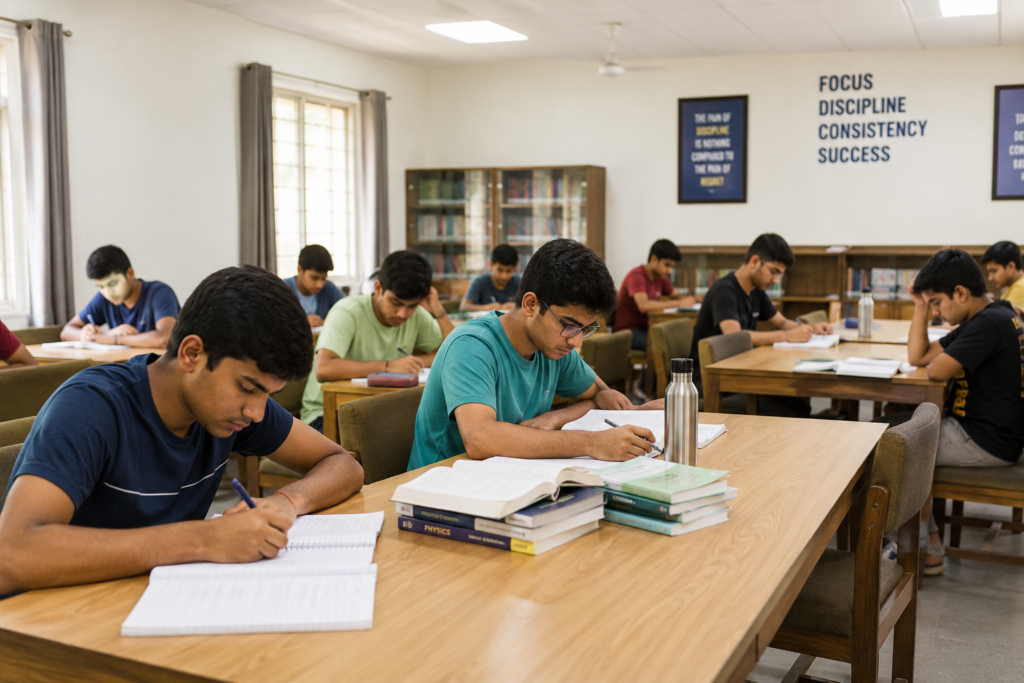
The Real Enemy Isn’t a Lack of Talent — It’s Decision Fatigue
A day-scholar student preparing for MPC or BiPC faces dozens of small decisions that have nothing to do with syllabus: what to wear, when to leave home, whether to reply to that WhatsApp group, how long to spend on Instagram “just for five minutes,” what time to sleep after finishing homework, whether to skip today’s revision because a cousin is visiting. Each decision seems trivial on its own. Stacked over 730 days of an intermediate journey, they quietly drain the mental energy that should be going into Physics numericals and Organic Chemistry mechanisms.
A well-run residential campus removes most of these micro-decisions before they can even form. Wake-up time, meal time, study blocks, doubt-clearing sessions, and lights-out are fixed.
The student doesn’t decide whether to study at 6 a.m. — the routine has already decided it for them. This isn’t about controlling a child; it’s about protecting their limited daily willpower for the one decision that actually matters: solving the next problem correctly.
Structure Beats Motivation, Every Single Day
Motivation is famously unreliable. It’s high before an exam and low on a rainy Tuesday in September when the syllabus feels endless. Toppers rarely rely on motivation to get through a study session — they rely on structure that runs regardless of how they feel that day.
This is where a residential routine quietly does its best work. A fixed timetable with morning study hours, school/college sessions, evening doubt-clearing, and structured revision means a student shows up to the desk at the same time every day, whether they “feel like it” or not. Over months, this consistency compounds into something that looks like talent from the outside but is really just repetition without interruption.
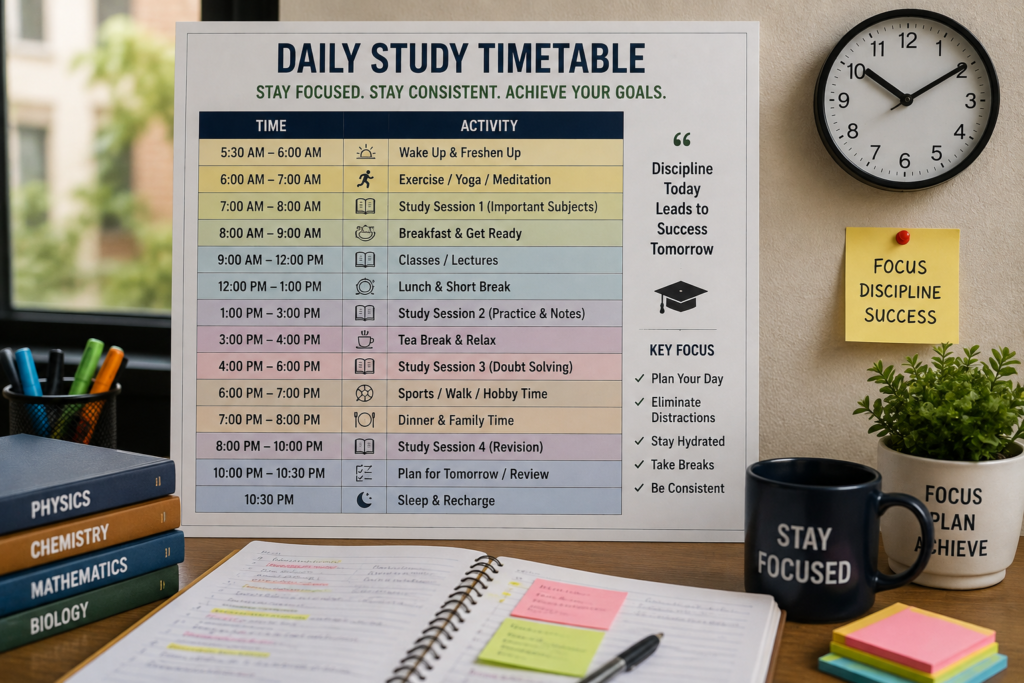
What Distraction-Free Actually Means in a Residential Setup
It’s worth being precise here, because “distraction-free” doesn’t mean isolation or joylessness. It means:
- No smartphone-driven attention fragmentation. Notifications, reels, and group chats are the single biggest silent thief of study hours for a 16–18-year-old today. Removing constant phone access during study blocks isn’t punishment — it’s giving the brain back its ability to go deep on one topic for 90 uninterrupted minutes.
- No commute fatigue. A student traveling 1–2 hours each way to a coaching center arrives tired and leaves late, losing prime study energy to traffic. On a residential campus, the classroom, hostel, and study hall are minutes apart.
- No inconsistent home environment. Family functions, younger siblings, household noise, and irregular meal times are normal parts of home life — but they’re also unpredictable variables in a two-year exam preparation window. A structured campus keeps the variables constant so effort can compound.
- Peer environment that reinforces focus, not competes with it. When every student around you is also studying at 6 a.m., focus becomes the norm rather than the exception. This peer pressure works in the student’s favor instead of against it.
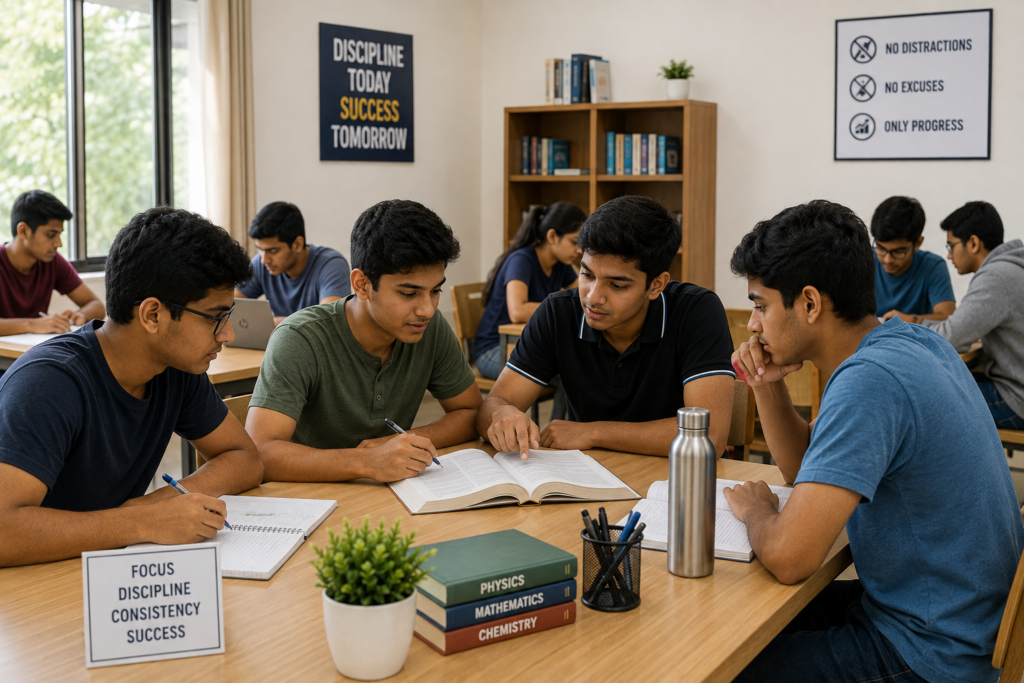
Mentorship Fills the Gap That Discipline Alone Can’t
Removing distraction only gets a student halfway there. The other half is knowing what to focus on and why — which is where personal mentorship becomes the difference between a disciplined student and a genuine topper. A student who studies eight focused hours a day but on the wrong priorities, or without anyone tracking their weak areas, will plateau. A residential environment that pairs a distraction-free schedule with regular one-on-one mentor check-ins — reviewing test performance, correcting concept gaps early, and adjusting the plan for each individual rather than the whole batch — turns raw discipline into targeted improvement.
This is also why, at VR Junior College, blind rank-chasing rarely produces the best long-term outcomes. A student pushed into a single narrow target (say, only an IIT seat or only a government medical seat) without anyone assessing whether that path suits their actual strengths often burns out under pressure rather than performing at their peak. The residential toppers who consistently do well tend to come from environments where mentors first understand the student, then design the discipline and route around them — not the other way around.
![One-on-one mentor guidance session with a student — placeholder: photo of a faculty mentor guiding an individual student]
Food, Sleep, and Health: The Quiet Multipliers
It’s easy to reduce exam preparation to “hours studied,” but a distraction-free routine also protects the two things students most often sacrifice under pressure: sleep and nutrition. Late-night cramming sessions and skipped meals feel productive in the moment but degrade memory retention and concentration within days. A residential campus with fixed meal times, hygienic food, and enforced sleep hours isn’t a “soft” feature — it’s a performance input as important as the physics revision itself. Toppers aren’t the students who sacrifice health for hours; they’re usually the ones whose routine protected both.
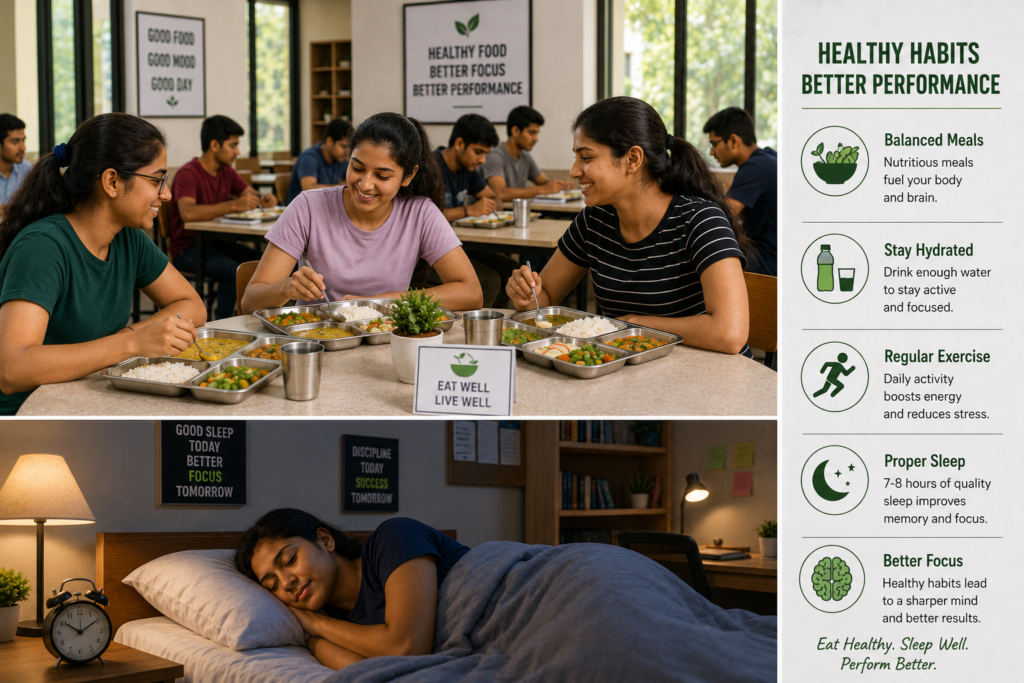
Building the Right Environment, Not Just the Right Student
None of this means every child needs to leave home to succeed. Day-scholar students with strong self-discipline and supportive families do well too. But for the average 16-to-18-year-old navigating two of the most competitive exams in the country, a structured, distraction-free, mentor-guided environment consistently produces more consistent results than willpower alone — because it removes the daily fight against distraction and replaces it with a system that does the fighting for them.
This is the quiet, unglamorous secret behind most residential toppers: not superhuman focus, but a routine engineered so focus doesn’t have to be superhuman at all.
If you’re evaluating a residential setup for MPC or BiPC preparation in Hyderabad, VR Junior College is built around exactly this idea — structured residential campuses, personal mentorship instead of blind rank-chasing, and dedicated MPC (IIT-JEE) and BiPC (NEET) streams designed around each student’s strengths. Visit vrjuniorcollege.com to explore campuses, courses, and admissions for 2026–27.
