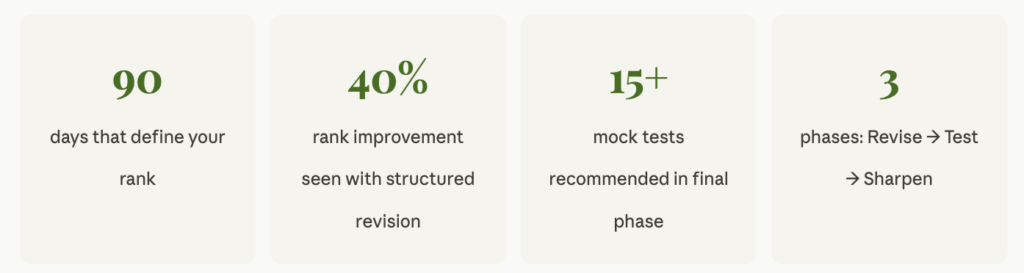
The final 90 days before NEET or IIT-JEE is the most critical window of your entire preparation journey. By this stage, you’ve covered the syllabus. The textbooks are worn. The notes are stacked. But here’s the truth most students miss: knowing the content and performing under exam conditions are two completely different skills. The last three months are where you build the second one.
This is a phase-by-phase, strategy-by-strategy guide to making those 90 days count — and turning months of hard work into an actual rank.
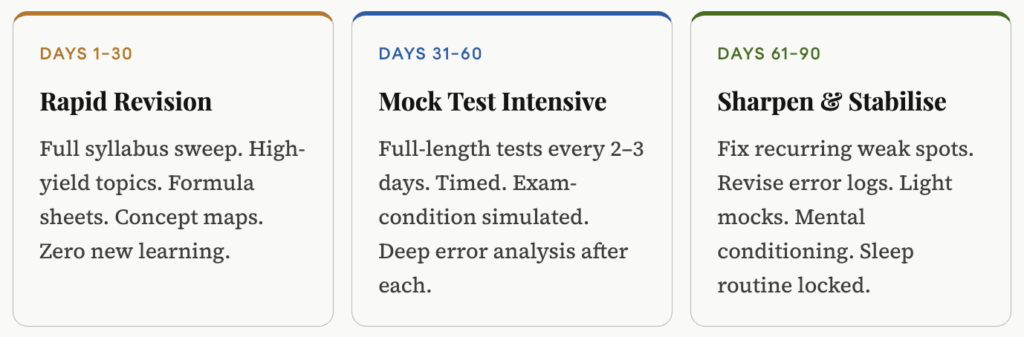
Break it into three phases
Treating 90 days as one undifferentiated stretch leads to burnout and poor prioritisation. Instead, divide it deliberately:
1. Stop learning, start consolidating
The single biggest mistake in the final 90 days is picking up new chapters or coaching material you haven’t touched before. Your brain’s job right now is not intake — it’s retrieval. Every hour spent on new content is an hour stolen from mastering what you already know. Compile your existing notes into crisp one-page topic summaries and revise those instead.
Action step: Make a “revision sheet” for every chapter — one A4 page with key formulas, exceptions, and tricky points. Review each sheet once every 10 days. By exam day, you’ll have seen every page nine times.
2. Mock tests are not practice — they are performance
Most students take mocks, check their score, and move on. That approach wastes 80% of the value. The real work happens after the test. Spend at least as much time analysing a mock as you spent taking it. For every wrong answer, ask: Was it a concept gap? A reading error? A time panic decision? Each answer type needs a different fix.
- Take the full mock under strict time and exam conditions.
- Mark every question as: confident correct / uncertain correct / wrong.
- Review uncertain-correct answers first — these are your hidden traps on exam day.
- Log every wrong answer into an error notebook with the corrected reasoning.
3. Prioritise high-weightage, high-frequency topics
Not all topics are equal. In NEET, chapters like Human Physiology, Genetics, and Organic Chemistry appear in almost every paper. In IIT-JEE, Calculus, Mechanics, and Electrochemistry carry disproportionate weight. In your final 90 days, spend 60% of your time on the top 30% of high-yield topics. This isn’t cutting corners — it’s intelligent resource allocation.
Smart revision: Download the last 10 years of previous papers for your exam. Count how many times each chapter appears. Sort chapters by frequency. That’s your revision priority list — built from data, not guesswork.
4. Build your speed without sacrificing accuracy
Speed and accuracy feel like opposites but they’re not — they’re both products of familiarity. When you’ve seen a question type fifty times, you recognise the pattern and move fast without losing precision. The way to build this is targeted drills: take 20–30 questions from a single topic under a tight time cap, repeatedly, until your per-question time drops naturally. Don’t rush — let speed emerge from mastery.
Watch out: Forcing speed by skimming questions leads to misreads and careless errors. Speed should come from pattern recognition, never from reading less carefully.
5. Track your weak areas like a data analyst
After every mock test, maintain a running error log — a simple table with chapter, question type, and reason for error. Review this log weekly. You’ll notice patterns: maybe you consistently drop marks in Thermodynamics or always misread assertion-reason questions. Once you can see the pattern, you can fix it with targeted 30-minute daily sessions on that specific weakness.
6. Master the art of the strategic skip
In the exam hall, time is your most limited resource. Develop a clear personal rule: if you can’t make progress on a question within 60–90 seconds, mark it and move. Students who get stuck on hard questions and burn 4–5 minutes often run out of time on questions they actually know. Skipping strategically is a sign of exam maturity, not weakness.
7. Protect your mental and physical health
Cognitive performance degrades sharply with poor sleep, poor nutrition, and chronic stress. In the final 90 days, your study schedule and your health schedule are equally important. Aim for 7–8 hours of sleep, brief 10-minute movement breaks every 90 minutes of study, and at least one complete rest evening per week. Burnout in week 10 of 13 destroys rank — consistency does not.
Performance fact: Sleep is when your brain consolidates memory. Pulling all-nighters before a revision test actively reduces the information you retain. A well-rested 6-hour study day beats a sleep-deprived 12-hour one, every time.
8. Simulate exam-day conditions exactly
By the time you sit your actual exam, the environment should feel unremarkable — because you’ve been there dozens of times in practice. Start your mocks at the same time as the actual exam. Use the same materials. Take the same breaks. Eat the same pre-test meal. When the real day comes, your body and brain are already calibrated. Anxiety drops. Focus rises.
9. Use the last two weeks as a confidence lap, not a sprint
The final 14 days are not for new revision or new mocks. They’re for reviewing your strongest material, re-reading your error log one final time, and going into the exam with a sense of controlled confidence. Light revision of your one-pagers, a couple of half-length mocks, and early sleep should define this window. Trust the work you’ve already done.
The bottom line
A rank is not won in the exam hall — it’s won in the 90 days before it. Students who treat this phase with discipline, structure, and intelligent prioritisation consistently outperform those who simply study harder. Work smarter, analyse deeply, rest seriously, and walk in knowing you’ve done everything right.